Computational Cognition Laboratory

Models of the thinking mind, tested against the brain.

We build mathematical and computational accounts of how minds perceive number, hold things in memory, track time, process language, and reason — then test them with psychophysics, EEG, and neural-network modelling. Based at the School of Interwoven Arts and Sciences, Krea University.

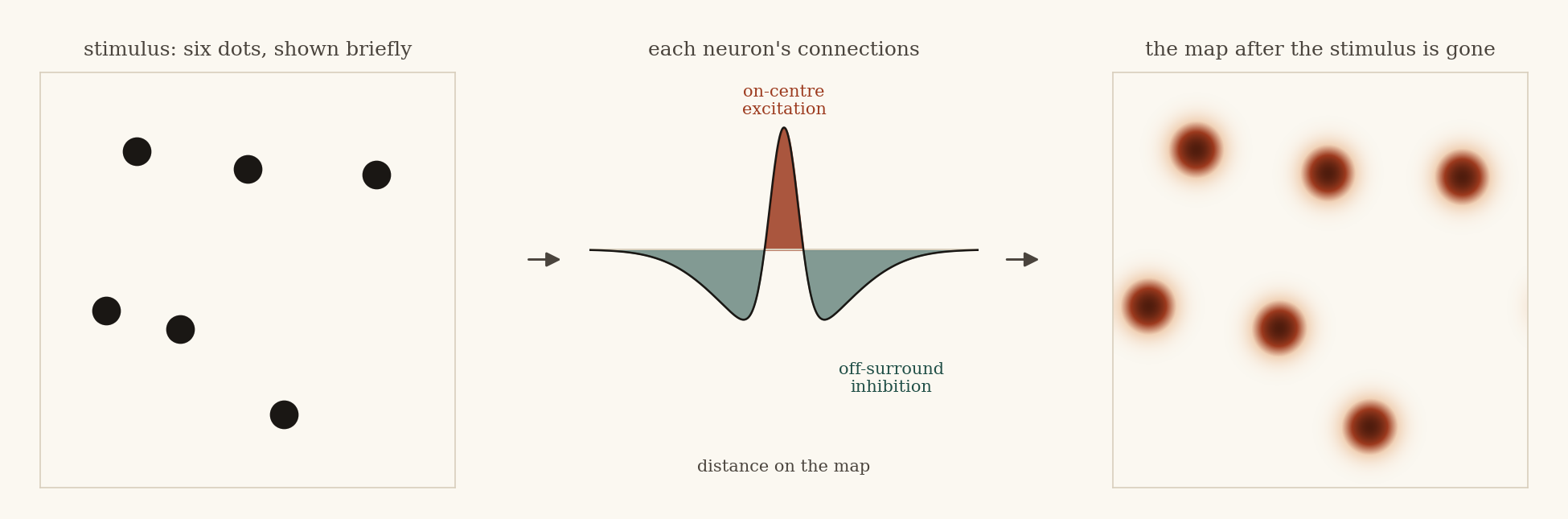
A six-dot stimulus, the on-centre off-surround connection profile, and the network map holding six bumps after the stimulus is gone.
The lab's workhorse model. Six dots are flashed to an on-centre off-surround recurrent network (OCOS-RNN); each neuron excites its neighbours and inhibits a wider surround. After the stimulus is gone the map holds six self-sustaining bumps, one per dot: a visual sense of number emerging from the dynamics. The same mechanism accounts for working-memory capacity and the subjective expansion of time.
01

Research Themes

A single mechanistic thread runs through the lab's work: the on-centre off-surround recurrent neural network (OCOS-RNN), a dynamical model whose lateral-inhibition parameter behaves as a shared computational signature across perception, memory, and time.

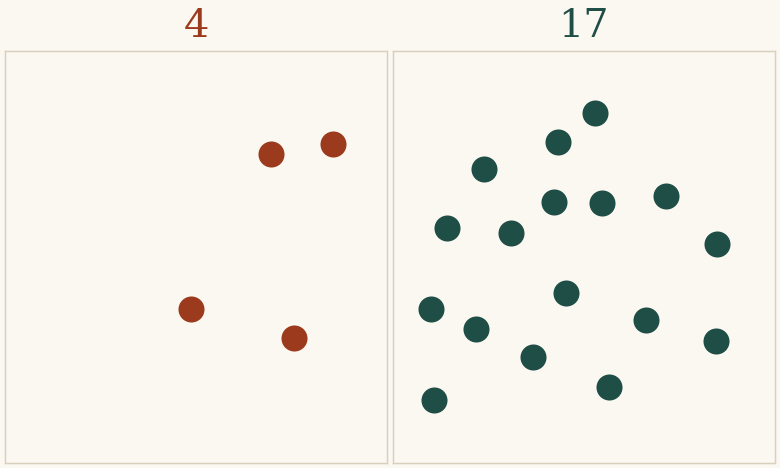
Two dot arrays: four dots and seventeen dots T1

Numerical Cognition & Dyscalculia

Subitizing, estimation, and the neural basis of the approximate number sense; computational phenotyping of numerical ability and dyscalculia screening in Indian school populations with the open DyscalcBattery.

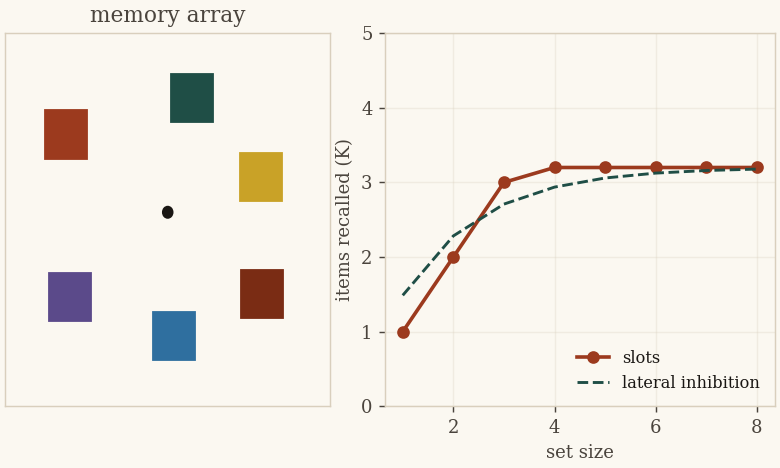
A memory array of coloured squares and a capacity curve T2

Visual Working Memory & Attention

Capacity limits, feature binding, change detection and the attentional blink, modelled with distance-dependent inhibition and tested with psychophysics and EEG.

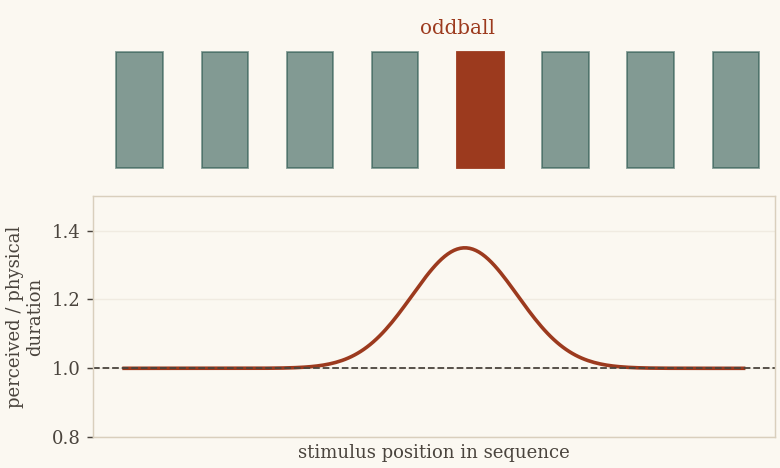
An oddball in a sequence and the resulting expansion of perceived duration T3

Temporal Cognition

Subjective time, the oddball expansion effect, and serial memory — accounted for through the dynamics of recurrent networks rather than a dedicated clock.

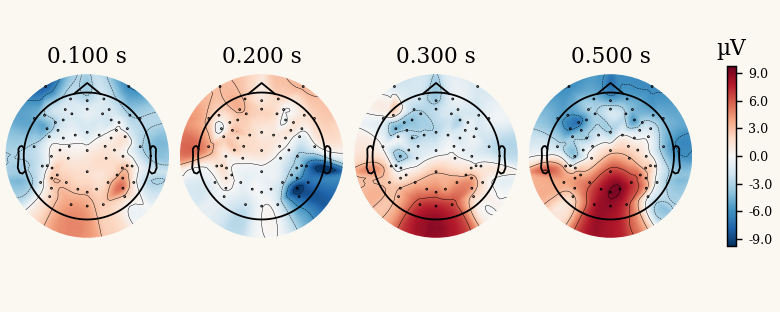
Scalp topographies of an event-related potential at four latencies T4

EEG & Brain–Computer Interfaces

Covert and overt speech, P300 and SSVEP paradigms, ocular-artifact removal, and source-reconstructed BCI, including assistive interfaces for limited-mobility users. Recorded on the lab's 64-channel EGI system.

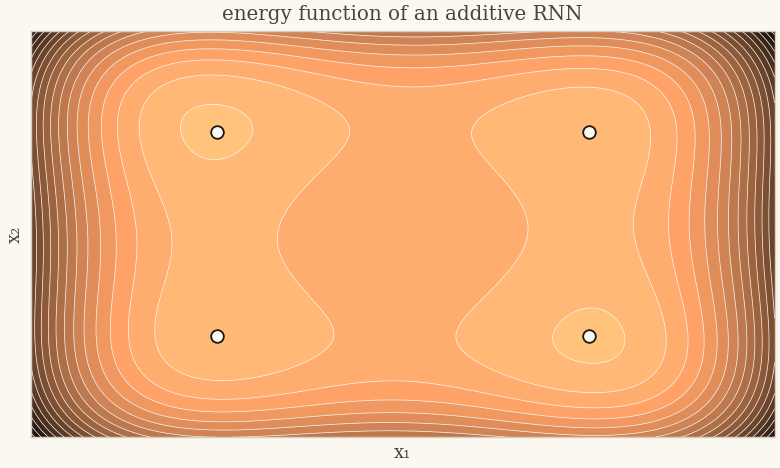
Contour plot of an energy function with four attractors T5

Recurrent Network Theory

Energy-function and Hamiltonian formalisms for additive and shunting recurrent networks; stability analysis, oscillatory dynamics, synchronisation, and bio-inspired variance control for neuromorphic systems.

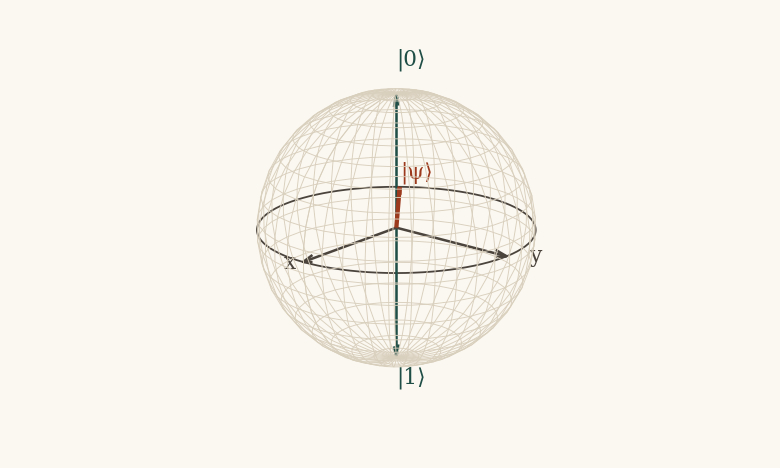
A Bloch sphere with a state vector T6

Quantum Machine Intelligence

Mapping classical recurrent dynamics into open-system quantum neural networks — Hamiltonian formulations, decoherence, and modular quantum reservoir computing with high noise resilience.

EEG  EGI NetStation 64-channel HydroCel system Compute  SIAS HPC cluster Methods  Psychophysics · jsPsych · PsychoPy · MNE · EEGLAB Modelling  OCOS-RNN · QRNN · Nengo Open tools  DyscalcBattery (MIT) · silent_articulation_eeg
02

Training & Events

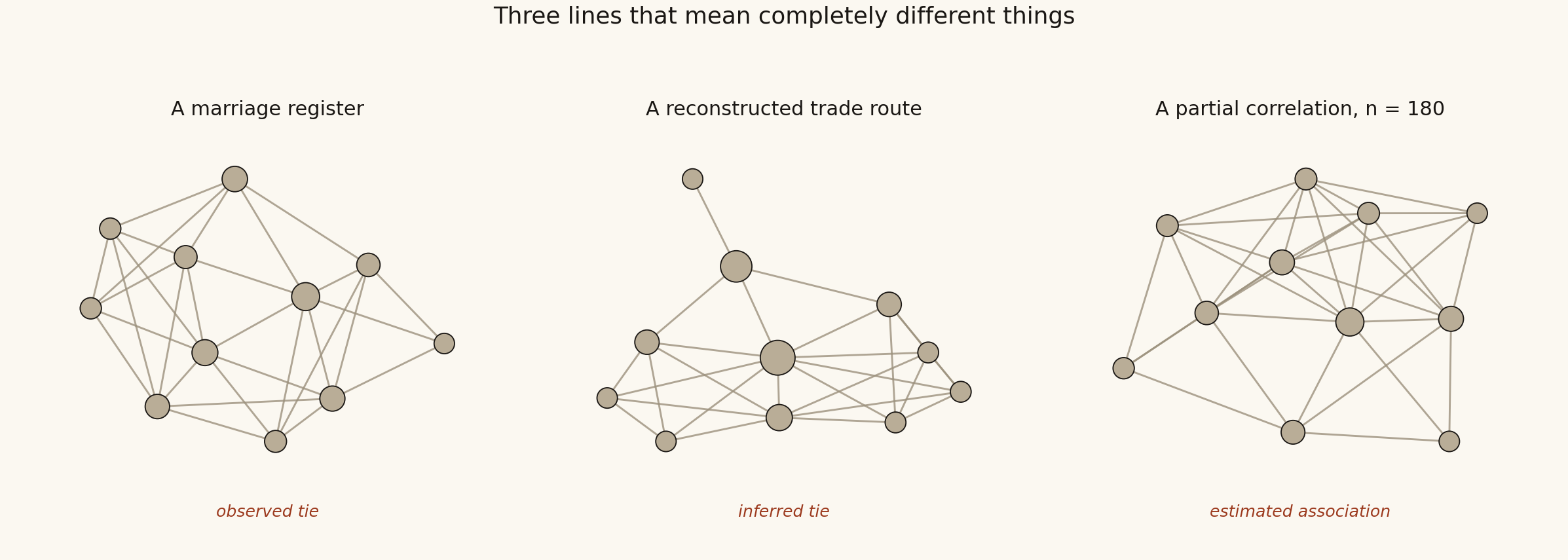
Three near-identical network diagrams labelled observed tie, inferred tie and estimated association
Two-day bootcamp · Upcoming

Networks of People, Places and Symptoms

Saturday 31 October & Sunday 1 November 2026 · 09:30–17:00 · SIAS, Krea University

Qualitative and quantitative social network analysis, taught entirely by hand — no software, no coding, no prerequisites. Sixteen Florentine families, fourteen Indian Ocean ports, and a small social world each group maps itself, ending with the question the whole camp is built on: the same picture can mean a marriage, an inferred trade route, or a partial correlation, and nothing in the image tells you which.

Sign up Programme
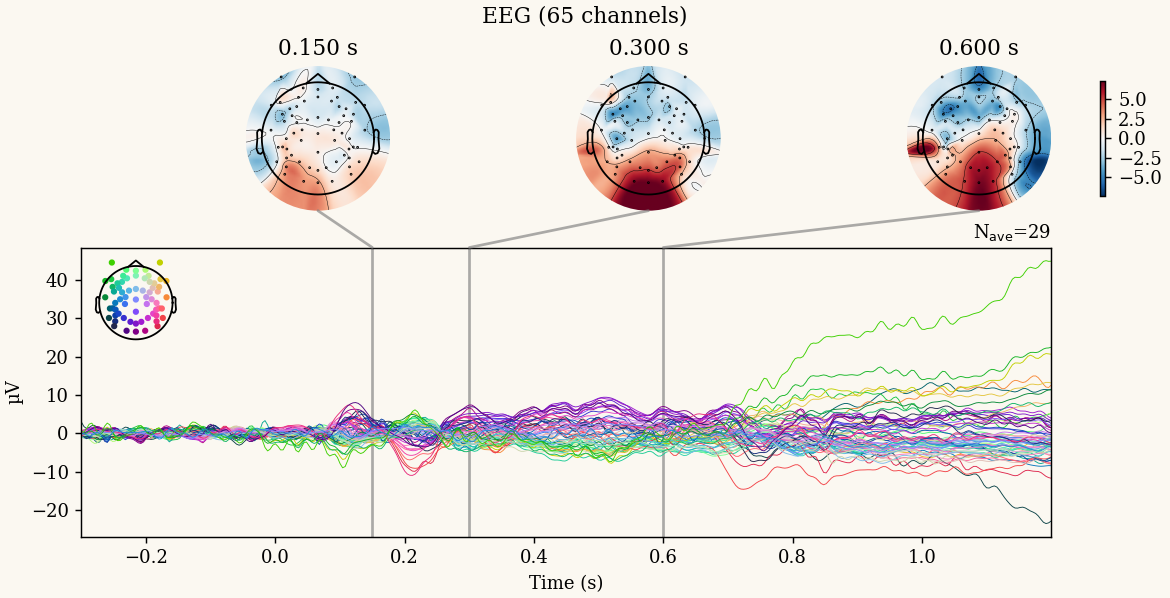
Butterfly plot of an event-related potential with scalp maps at three latencies
One-day workshop · PSYC239 · Held

EEG Analysis Bootcamp

Saturday, 12 September 2026 · 09:15–17:00 · SIAS, Krea University

From a raw 64-channel recording to a clean event-related potential, twice: scripted in Python with MNE, then replicated in MATLAB with EEGLAB. Every participant works on a real recording from the lab's covert/overt articulation study and leaves with a notebook, a script, and a Methods paragraph they can defend.

Photographs Programme
03

Publications

Books, articles and chapters from the lab. Full record on ORCID.

Books

Introduction to Psychophysics with Python
Rakesh Sengupta & Maganti Madhavilatha · River Publishers, 2026 · ISBN 978-87-438-0944-9
Mind, Model, and Complexity
Rakesh Sengupta · River Publishers, 2026 · In press
Advancing Alzheimer's and Parkinson's Diagnosis and Treatment with Sustainable AI
R. Sengupta, G. R. Naik & U. Desai (Eds.) · Springer Nature, 2026
Applied Artificial Intelligence and Machine Learning Techniques for Engineering Applications
R. Janapati, U. Desai, S. L. Fernandes, R. Sengupta & S. Tayal (Eds.) · CRC Press, 2025

Journal & Conference Articles

04

People & Collaborators

The lab works closely with undergraduate and graduate students at Krea and with an international network of collaborators in numerical cognition, vision science, formal linguistics, and quantum information.

PI

Rakesh Sengupta

Principal Investigator. PhD in Cognitive Science, University of Hyderabad (2015). Postdoctoral work at the Centre for Vision Research, York University, and at IIT-Madras; visiting fellow at CIMeC, University of Trento.

Long-standing Collaborators

David Melcher & Manuela Piazza (Trento), John K. Tsotsos (York), Surampudi Bapi Raju (IIIT-Hyderabad), Ravichander Janapati & Usha Desai (SR University), Anuj Shukla, Maganti Madhavilatha & Sayantan Mandal (Krea).

+

Alumni

Bhavesh Verma (IISER Pune, now co-author on numerosity decoding), Aswini Madhira and Christelle M. Lewis (JRFs, SR University), Srishti Jain and Sumit Pareek (CCT Rajasthan), Adwititya Roy (Krea capstone).

Current students & projects

Nihala Abdul SamedPhD (co-supervised): pluralistic ignorance and social network topology.
Lekhana Priya GundapaneniAlpha-band dynamics of covert and overt articulation (EEG), and its stress extensions; first author of the lab's silent-speech study. Co-author on the asymmetry of truth. Teaching Fellow, EEG Bootcamp.
Judith Grace LazarusComputational models of misinformation: the asymmetric pull of falsehood in echo chambers; the Asymmetry of Truth book project. Support, SNA Bootcamp.
Rakshitaasai KarthinarayananAffective enumeration: arousal as competition, valence as drive in the magnitude system. Teaching Assistant, EEG Bootcamp.
Parijat DeyCapstone: visual working memory under cognitive load, a complexity-theoretic reframing.
Bhumika AroraStress, synapses and the sense of number: developmental stress, caffeine and numerosity perception.
Jaimon PaulRhythmic neurodynamics: musical expertise and the subjective expansion of auditory time.
Aahana RathNarrative complexity and the attentional blink; Registered Report on visual narrative coherence.
Suzanne LiraniThe peer and the brain: complex contagion, second-person neuroscience and the reverse-inference trap.
Almas Sehr“Not feeling myself”: acute self-alienation as a complexity-budget overrun.
Manvi YadavAI and memory: AI-mediated remembering and source-monitoring failure (“Smoothing the Fracture”).
Anagha RaviThe one-criterion experiment: diagnostic-threshold labelling and social distance (with Judith Grace Lazarus).
Aarthi VenkateshMagnitude, morality and the symbolic mind; flicker-time EEG.
Mrinmayi BanginwarEnumeration and the connectome: continuation of the numerosity decoding work.
Archana NamboodiriEmotional use of AI systems.
Ananyaa PremanandThe temporal subaltern: gendered care work and temporal recognition.
Navyaa AggarwalEvents and the arrow of time.
Grishma NathwaniVector space versus mental space (with Tanvi Sundrani).
Tanvi SundraniVector space versus mental space (with Grishma Nathwani).
TrishaaStroop interference: task construction and piloting in PsychoPy.
Arush MenonMATLAB/EEGLAB pipelines; Teaching Assistant, EEG Bootcamp.
05

Curriculum Vitae

Appointments, education, talks, teaching and service. A full CV is available on request.

2025 –
Assistant Professor
School of Interwoven Arts and Sciences, Krea University, Sri City
2019 – 2025
Assistant Professor & Director, Center for Creative Cognition
SR University, Warangal
2018
Postdoctoral Researcher
Dept. of Biotechnology, IIT-Madras, Chennai
2015 – 2017
Postdoctoral Researcher
Centre for Vision Research, York University, Toronto (with John K. Tsotsos)
2015
PhD, Cognitive Science
University of Hyderabad · advisors Raju S. Bapi and Prajit K. Basu · thesis “Computational and Empirical Investigations of Number, Time, and Memory”
2012, 2014
Visiting PhD Scholar
Center for Mind/Brain Sciences (CIMeC), University of Trento, Italy · Indo-Trento Visiting Research Fellowships
2009 – 2015
Research Associate & Senior Research Fellow
CCNSB, IIIT-Hyderabad · Center for Cognitive Science, BVRIT-Narsapur (DST fellowships)
2005 – 2008
Junior Research Fellow (CSIR-UGC)
School of Chemistry, University of Hyderabad · MSc Chemistry, University of Calcutta (2005); GATE rank 42

Recent invited talks

  • 2026Spurious Specificity: How Attention and Meditation Research Mistakes Description for Cause — Dept. of Philosophy, University of Hyderabad
  • 2026Complexity as Constraint: From Visual Binding to the Grammar of Working Memory — EFL University, Hyderabad
  • 2024Cognitive Control and Numerosity: Voluntary Control in Go/No-go Tasks — NAOP 2024, GITAM University
  • 2024Enumeration and Perceptual Averaging Across Presentation Durations — Cognitive Science Seminar, IIIT Hyderabad
  • 2023Recalling a Single Object: Beyond the Capacity Debate — Ahmedabad University
  • 2023Time's Subjective Expansion in the Temporal Oddball Paradigm — NGN 2023, IISER Pune

Teaching

  • KreaProgramming for Psychologists (PSYC239) · Statistics and Research Methods · Personality Disorders (independent study)
  • SRUIntroduction to Computational Methods in Cognitive Neuroscience · Foundations of Cognitive Science · Design Cognition · Cognitive Management · Psychology

Outreach & workshops

  • 2026Networks of People, Places and Symptoms: a two-day social network analysis bootcamp, Krea University, 31 Oct–1 Nov (details)
  • 2026EEG Analysis Bootcamp, Krea University, 12 Sep (details)
  • 2024Designing Dynamic Experiments: a three-day online workshop on psychophysics with MATLAB/Octave
  • 2023Five-day FDP: Developments in Healthcare Data Processing
  • 2019Firki webinar “What Can Artificial Intelligence Teach Us!” (open educational resource)

Peer review

Cognition · Nature Human Behaviour · IEEE · IJCNN · Frontiers in Neuroscience

Memberships

National Academy of Psychology · International Brain Research Organization · American Psychological Association

Advisory & patents

Medical Advisory Board, Emvera (digital health). Co-inventor, “Artificial Intelligence Based Approach to analyze the neurological disorder that erupt during Covid-19 pandemic”, Indian patent application 202211013207 (2022, published).

06

Get in touch

Prospective PhD and master's students, collaborators, and visitors are welcome to write. The lab is interested in motivated researchers across computational neuroscience, psychophysics, and machine intelligence.

Email rakesh.sengupta@krea.edu.in ORCID 0000-0003-1768-0551 Code & data github.com/rakesh-sengupta Address SIAS, Krea University
Sri City, Andhra Pradesh 517 646, India