Two-day bootcamp · Social network analysis

Networks of People, Places and Symptoms

Saturday 31 October & Sunday 1 November 2026

Qualitative and quantitative social network analysis, taught entirely by hand. No software, no coding, no maths beyond counting, and nothing to install. Two days, six sessions, one argument: the same picture can mean completely different things.

Sign up Student brochure (PDF)
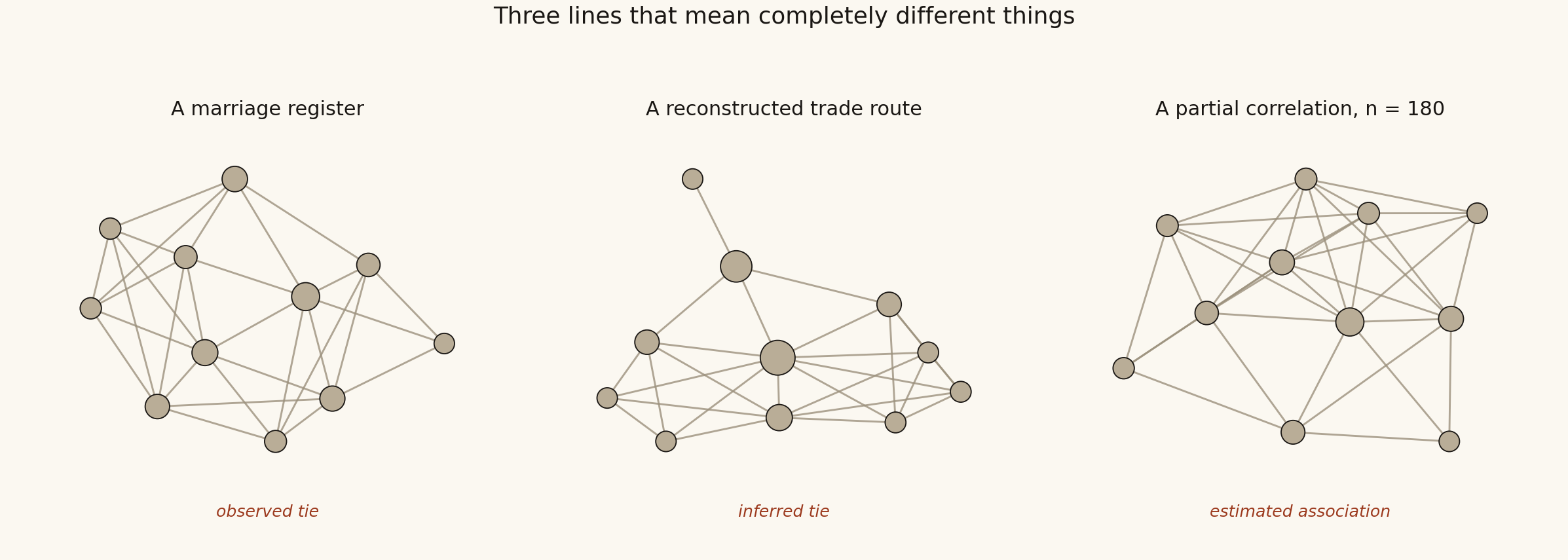
Three network diagrams that look almost identical, labelled observed tie, inferred tie, and estimated association
The claim the bootcamp is built around. Three networks of the same size and roughly the same shape. In the first, a line means two families were married. In the second, a line means historians infer two ports traded. In the third, a line is a partial correlation between two symptoms, estimated from a sample, with a confidence interval usually wide enough to include zero. Nothing in the images tells you which is which.
01

Registration

02

What the two days are about

Social network analysis is usually taught as a software course. Participants learn to produce a picture before they can say what the picture asserts, and the picture is persuasive out of all proportion to the evidence behind it. This bootcamp inverts that. Every quantity is counted by hand on networks small enough to hold in view, and the analytic work is the argument about what should count as a node and what should count as a tie.

Day 1

What counts as a tie

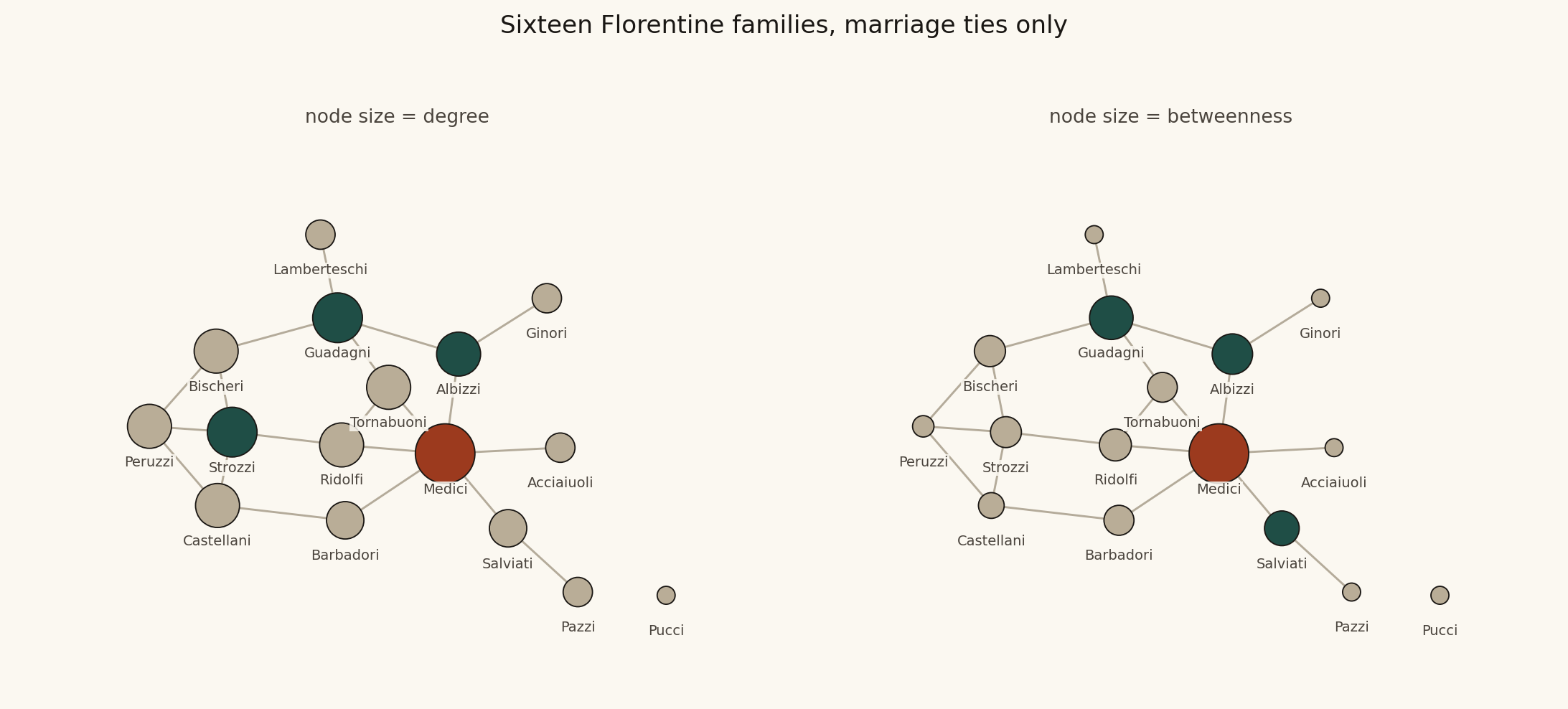
Nodes, ties and the adjacency matrix, built by hand. Sixteen Florentine families worked two different ways. Then your own group maps a small social world it shares, and commits to a sealed prediction about it.

Overnight

The only computation

The convenor turns every group's paper sheet into a laid-out diagram with degree and betweenness. That is the only time a computer touches anything all weekend.

Day 2

What structure does

Predictions opened against the machine-drawn version. Then the Indian Ocean as a knowledge network, Randall Collins on intellectual lineages, horizons of understanding, and the shift to symptom networks.

By the end, each participant can

  • say, for any network diagram, what the nodes are, what the edges assert and how the boundary was drawn;
  • build an adjacency matrix from a verbal description and compute degree, density and path length by hand;
  • explain why two tie rules over the same population give different answers about who is central;
  • tell an observed tie, an inferred tie and an estimated statistical association apart;
  • write a one-page network memo for a problem in their own field.

What you do not need

No laptop. There is no software in this bootcamp at all. No coding, on either day. No maths beyond counting. No reading beforehand — the reading list comes afterwards and is optional. No prior anything: we assume you have never heard the word “node”.

Two rules held throughout

Every metric is counted by hand before any machine computes it. And no more than five new terms per session, all of them on a printed glossary card handed out in the first ten minutes. Nothing is taught that is not on that card.

03

Schedule

Saturday 31 October · Seeing structure

TimeBlockContent
09:00ArriveSign in, glossary cards, groups seated. Tea available.
09:30Session 1What is a network? Nodes, ties, directed and undirected, the adjacency matrix as a table of ticks. Why relational data cannot be anonymised the usual way.
11:00Tea
11:15Session 2Sixteen Florentine families, worked two ways on chart paper. Degree by counting. The loudest session of the weekend.
13:00Lunch
14:00Session 3Your own network. Each group maps a small world it shares, pseudonymised at source, then counts and seals a written prediction.
16:00Wrap-upGlossary review; sheets collected; pseudonym keys destroyed in front of the room.

Sunday 1 November · Same mathematics, different worlds

TimeBlockContent
09:30Session 4Every group's network machine-drawn. Sealed predictions opened first. Bridges, brokers, structural holes and cut vertices, defined once they have seen instances of them.
11:00Tea
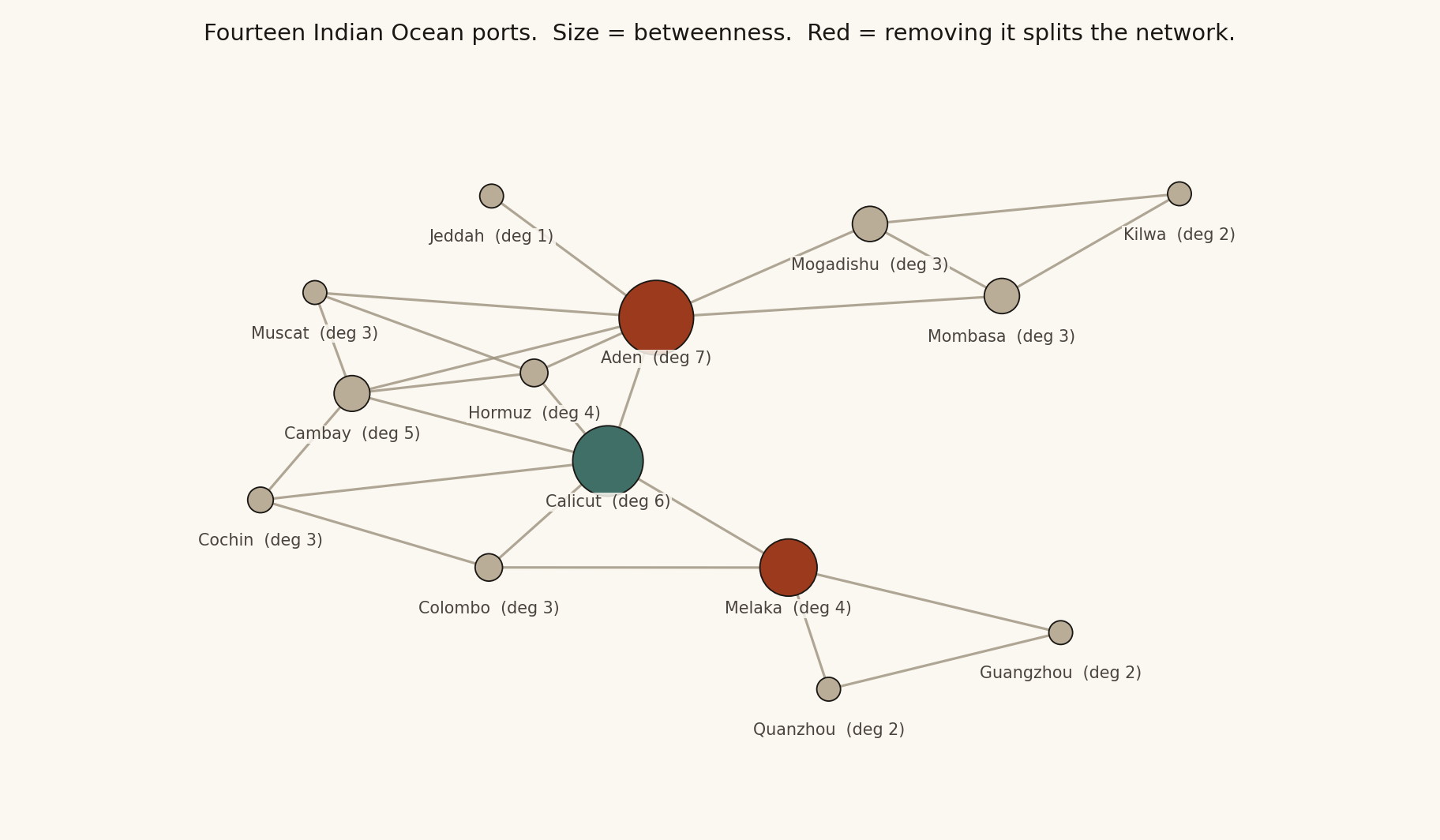
11:15Session 5Fourteen Indian Ocean ports. Remove one and the system breaks — which one? Then Randall Collins on teacher–student chains and the law of small numbers.
13:00Lunch
14:00Session 6Horizons of understanding, network closure, and the shift to a third kind of node. Guided demonstration on published symptom networks, with bootstrapped confidence intervals beside the pretty graph.
16:00CloseThe one-page memo, written in the room. Volunteers present. What we did not teach, named as a door rather than a gap.
04

The material, and what comes out of it

Three datasets, chosen so the same counting skill lands on radically different kinds of object. Everything below is worked on paper before anyone sees a computed version.

Student brochureFour pages. Exact timings, what each session asks of you, how loud each room will be, and every opt-out written down in advance.Download PDF
Full teaching planThe convenor's plan document: session-by-session detail, ethics protocol, datasets, worksheets and the overnight processing script.Download PDF
05

Access, and how the group work runs

The room

  • ·Leave any session at any time. No need to say why, ask permission, or explain on returning.
  • ·A quiet room next door for both days. Nobody will follow you into it.
  • ·Breaks are at fixed times and we do not run over into them.
  • ·Two sessions are genuinely loud — Saturday and Sunday 11:15, both flagged in the brochure. Bring ear defenders or loops if you use them.
  • ·Standard overhead lighting. Say so in advance if that is a problem and we will dim the room or seat you away from it.
  • ·Nothing is timed, graded or recorded. There is no test.

Groups, and the data you generate

We assign the groups. Three or four people, the same group both days, seated at registration. Tell us on the form if you are coming with someone you know.

You never have to be one of the dots. On Saturday afternoon your group maps a social world. If you would rather not be in it, say so and you still do every other part; this is announced to the whole room so declining is not conspicuous.

The questions are deliberately dull. Only who has studied or worked with whom. Nothing about liking, conflict, money or health. People outside the room appear as A1, A2, A3; real names never leave your table, and the key sheet is destroyed before anything is handed in. Submitted data is deleted within seven days.

Session 6 is announced before it starts. It uses published research on mental health, including personality disorders, as an example of the third kind of edge. Nobody rates themselves or anyone else on anything, and you are free to step out for that part.
06

Teaching team

Dr. Rakesh Sengupta
Convenor

Dr. Rakesh Sengupta

Assistant Professor, SIAS; Principal Investigator, Computational Cognition Laboratory. Works on network topology in misinformation spread and on complexity accounts of cognition. Teaches all six sessions and runs the overnight processing.

Support

Judith Grace Lazarus

Floor support across all hand-work sessions, keeper of the glossary board, and timekeeper. Author of the lab's computational work on temporal narrative drift in echo chambers, which is where the bootcamp's interest in network topology as a cause rather than a description comes from.

07

Practical information

Questions about what a session involves, whether you will be made to speak, whether you can bring a problem from your own discipline, or anything you would like arranged in advance: write to the convenor. Asking before you decide is completely normal and gets a straight answer.

DatesSaturday 31 October & Sunday 1 November 2026 Time09:00 arrival · sessions 09:30–17:00 VenueSIAS, Krea University, Sri City Registration closesFriday 23 October 2026 Contactrakesh.sengupta@krea.edu.in